Enroll Today

MLRO Certification

Format

Self Paced Virtual Training

Starting date

Available Now

Duration

8 Sections x Approx 4 Hours
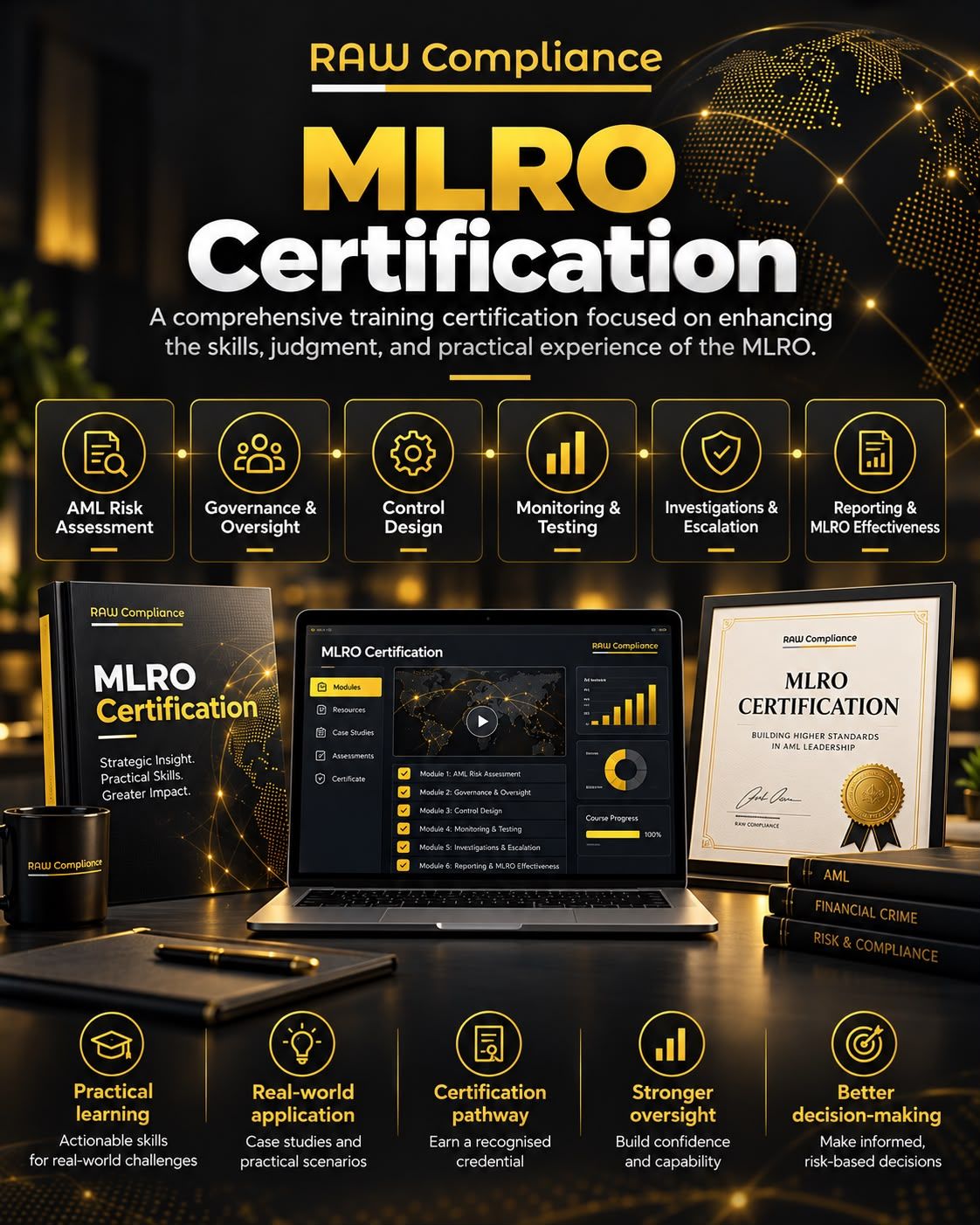
MLRO Certification: practical training for Money Laundering Reporting Officers.
Build the judgement and practical skills an MLRO needs.
Who it's for: current and aspiring MLROs and compliance practitioners in banking, fintech and crypto firms.
What you'll work on: MLRO responsibilities, your first 90 days, financial-crime risk assessment, CDD, transaction monitoring, control reviews and clear reporting to senior management, auditors and regulators.
Author and trainer: Oonagh van den Berg, founder of RAW Compliance.
Learning and CPD: self-paced study, with a published estimate of 8 sections of approximately 4 hours. This is not an externally accredited CPD award. Record the learning you complete and check your professional body's rules. Certificate requirements are set within the course.
Free access. No subscription or card required.
WHAT YOU ARE GOING TO LEARN

Course Structure

Part 1: The Role of an MLRO
I. Introduction
  • The role of an MLRO - overview of the role and expectations
  • Experience, skillsets and qualifications 
  • Regulatory appointment requirements

Part 2: Global Regulatory Landscape
I. Regulatory Landscape
  • Comparative overview of various global regulatory financial Crime regulators and rulebooks
  • UK Focused - FCA regulations related to Financial Crime
  • Recent updates and changes in regulatory requirements including case law and news articles for risk awareness in new and emerging risks
II. Regulatory Forecast
  • Anticipating future regulatory changes and trends in AML
  • Strategies for staying ahead of evolving compliance requirements
  • Industry experts providing insights into the regulatory landscape over the next few years

Part 3: First 90 days – upskilling in awareness of risks in your new role
I. The Importance of Your First 90 Days
  • Essential steps for MLROs in their initial 90 days in the role
  • Building relationships with key stakeholders, both internal and external
  • Developing a strategic plan for AML program risk understanding, awareness and key risks/enhancement within the first 90 days
    II. Focus on Senior Executive Interactions
    • Importance of fostering a culture of compliance from the top-down
    • Effective communication strategies for MLROs with senior executives
    • Case studies highlighting successful senior executive engagement in AML initiatives
    Part 4: AML Risk Assessment
    I. Identifying AML Risks

    • Risk categories

    • Red flags and indicators of money laundering
    • Conducting risk assessments: tools and methodologies
    II. AML Risk Assessment Process
    • Steps for conducting an AML risk assessment
    • How to document and provision of templates
    • Gathering and analyzing relevant data.
    • Assessing risk levels and prioritizing risks.
    • Documenting findings and recommendations into the template and calculation of actual versus control mitigated residual risk

    Part 5: Financial Crime Control Processes – CDD and Transaction Monitoring

    I. Client File Reviews
    • Importance of thorough client file reviews in AML compliance
    • Developing effective client file review procedures.  
    • Case studies highlighting the impact of robust client file reviews on detecting and preventing money laundering activities
    • Break out session - Conducting client files reviews: Natural Person, Legal Person and Legal Arrangements


    II. Transaction Monitoring
    • Role of transaction monitoring in identifying suspicious activities
    • Choosing, Implementing and Calibrating transaction monitoring systems
    • Real-life examples showcasing the success of transaction monitoring in preventing financial crimes and Industry trends and emerging challenges in transaction monitoring
    • Break Out Session - Performing Transaction Monitoring Alert Reviews
    • Continuous improvement strategies for transaction monitoring

    Part 6: Reviewing your Risk Controls

    This section provides a structured framework for MLROs to review and enhance manual and automated risk procedures and workflows.

    By following a systematic assessment framework and implementing improvements based on review findings, participants can strengthen their organization's risk management practices and ensure compliance with regulatory requirements- to gain valuable insights into optimizing their manual monitoring processes for better compliance outcomes.


    Section a: Manual Procedures
    I. Introduction to Manual Risk Procedures and Workflows
    • Define manual risk procedures and workflows
    • Importance of effective risk management in regulatory compliance
    • Overview of the compliance officer's role in reviewing manual processes

    II. Understanding Key Risk Procedures
    • Overview of manual risk procedures commonly used in compliance, key risk areas and associated procedures
    • Roles and responsibilities of stakeholders involved in manual risk management

    III. Assessment Framework

    • Introduction to a structured assessment framework for reviewing manual risk procedures
    • Key performance indicators (KPIs) for evaluating effectiveness
    • Criteria for assessing adherence to regulatory requirements and internal policies
    IV. Review Process
    • Step-by-step guide to conducting a comprehensive review of manual risk procedures and workflows
    • Techniques for gathering relevant data and documentation
    • Tools and templates for organizing review findings
    V. Identifying Gaps and Areas for Improvement
    • Analysis of review findings to identify gaps or deficiencies in current practices
    • Group discussion on common challenges and shortcomings in manual risk procedures
    • Prioritization of areas for improvement based on risk severity and impact
    VI. Implementing Enhancements
    • Strategies for implementing enhancements to manual risk procedures and workflows
    • Collaboration with relevant stakeholders to address identified gaps
    • Consideration of technological solutions to streamline manual processes
    VII. Monitoring and Continuous Improvement
    • Importance of ongoing monitoring to ensure sustained effectiveness
      Establishment of performance metrics to track improvements over time
    • Integration of feedback loops for continuous process improvement

    Section B: Automated Procedures

    I. Introduction to Automated Controls
    • Define automated controls and their role in compliance
    • Importance of automated controls in detecting and preventing compliance risks
    • Overview of the compliance officer's role in reviewing automated controls

    II. Understanding Automated Control Mechanisms
    • Types of automated controls commonly used in compliance
    • Explanation of control mechanisms and their functions
    • Identification of key control points and associated risks
    III. Assessment Framework
    • Introduction to a structured assessment framework for reviewing automated controls
    • Key performance indicators (KPIs) for evaluating control effectiveness
    • Criteria for assessing reliability, accuracy, and completeness of automated controls
    IV. Review Process
    • Step-by-step guide to conducting a comprehensive review of automated controls
    • Techniques for gathering relevant data and documentation
    • Tools and software for analyzing control performance and effectiveness
    V. Testing and Validation
    • Importance of testing and validation in assessing the reliability of automated controls
    • Methods for conducting test scenarios and simulations
    • Validation of control outputs against expected results
    VII. Identifying Weaknesses and Areas for Improvement
    • Analysis of review findings to identify weaknesses or deficiencies in automated controls
    • Group discussion on common challenges and limitations in automated control mechanisms
    • Prioritization of areas for improvement based on risk severity and impact
    VII. Enhancement Strategies
    • Strategies for enhancing the effectiveness of automated controls
    • Collaboration with IT and technology teams to implement control improvements
    • Consideration of regulatory requirements and industry best practices in control enhancements
    VIII. Monitoring and Continuous Improvement
    • Importance of ongoing monitoring to ensure sustained effectiveness of automated controls
    • Establishment of performance metrics to track control performance over time
    • Integration of feedback loops for continuous control improvement
    Section c: Assessing Your Technology Needs 
    I. Identifying Right Technology Needs
    • Reviewing and Assessing the financial crime technology requirements for your business including name screening and transaction monitoring
    • Practical considerations in selecting and implementing technology solutions for effective anti-money laundering measures
    • Integration of artificial intelligence and machine learning in transaction monitoring
    • Case studies demonstrating successful outcomes from utilizing cutting-edge technology in combating financial crimes

    Part 7: Financial Crime Investigations, Assurance, Inspections and Reporting
    I. Ongoing Reporting
    • Ensuring ongoing compliance with FCA regulations
    • Reporting requirements and mechanisms for MLROs
    • Case studies of compliant organizations 
    II. Suspicious transaction assessment and FIU reporting
    • Advanced techniques for assessing suspicious transactions
    • Criteria for escalating transactions to the Financial Intelligence Unit (FIU)
    • Collaboration with the FIU in reporting and investigating suspicious activities
    • Understanding the role of the Financial Intelligence Unit (FIU)
    • Navigating the process of reporting suspicious transactions to the FIU
    • Collaborative approaches between MLROs and FIUs in conducting investigations - Enhancing collaboration between MLROs, FIUs, and law enforcement
    • Navigating cross-border implications in FIU reporting and investigations
    • Incorporating lessons learned from complex and high-profile cases into AML programs
    III. Annual AML Report
    • Crafting comprehensive and accurate annual reports for regulatory authorities
    • Highlighting key metrics and success stories in annual reports
    • Addressing challenges and common pitfalls in annual reporting processes
    • Integrating FIU reporting outcomes into comprehensive annual reports
    • Demonstrating the impact of FIU collaboration on AML program effectiveness
    • Common challenges and best practices in annual reporting with a focus on FIU-related activities
    IV. Dealing with Audits and Regulatory Inspections
    • Preparing for regulatory audits and inspections
    • Best practices in responding to audit findings
    • Case studies illustrating successful outcomes from regulatory inspections

    Part 8: MLRO – Crisis Management and Training
    I. Crisis Management and Communication
    • Developing a crisis management plan for AML incidents
    • Effective communication strategies during crises
    • Case studies of organizations successfully managing and recovering from AML-related crises
    II. Ongoing training and upskilling
    • Specialized training on FIU reporting and investigation techniques
    • Opportunities for ongoing education specific to FIU-related challenges
    • Strategies for maintaining expertise in evolving FIU procedures and technologies
    • Dedicated networking sessions for FIU professionals
    • Forums for sharing insights and experiences in FIU reporting and investigations


    Post Certification
    • Group alumni sessions
    • Access to course materials for 1 year from completion

    Speakers

    Oonagh van den Berg

    CEO & Founder of RAW Compliance
    About

    Oonagh van den Berg is an award winning compliance officer with over 20 years’ experience in financial services. She is one of the leading voices and trainers globally in compliance risk management and has built and led various compliance risk framework developments and teams across the industry for a diverse range of financial entities, including traditional banks, Fintechs, and Crypto firms. She is an advocate for ethical compliance leadership and framework development, with increased automation including AI and Machine Learning integration.
    Write your awesome label here.

    AI and Compliance
    Certification

    This course is designed to provide practitioners with a comprehensive understanding of compliance issues related to artificial intelligence (AI).  

    Write your awesome label here.

    CRFCC
    Certification

    Designed to empower professionals with the knowledge and skills necessary to navigate the complex world of cryptocurrency regulation and financial crime prevention.
    Write your awesome label here.

    RAW Product
    Training

    Each product and service training module covers the specfic set of features, risks, and regulatory considerations associated. 

    Write your awesome label here.

    RAW Technical Courses

    Designed to equip individuals or professionals with the necessary knowledge and skills to understand and adhere to the regulations, standards, and best practices.